
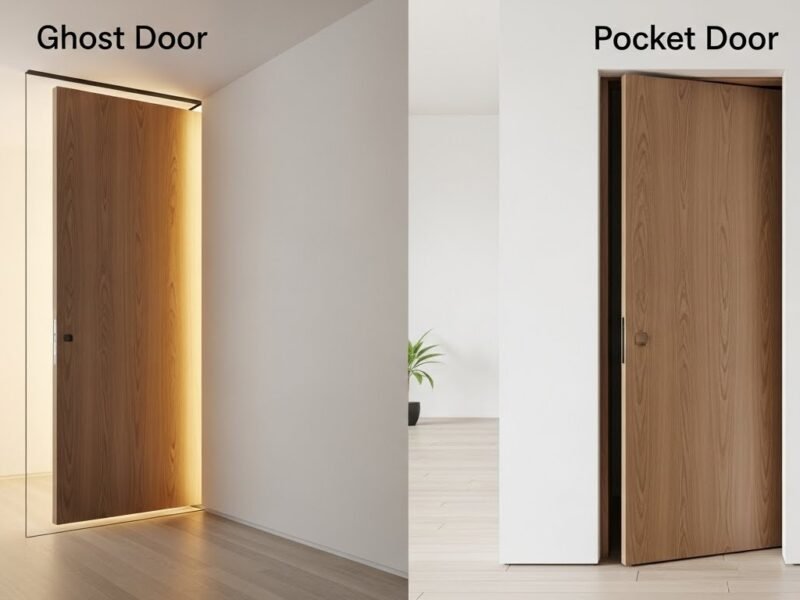
Choosing the right interior door affects your home’s space, ara, ati iṣẹ. Two increasingly popular options today are Ghost Doors ati Pocket Doors. While both offer a clean, igbalode wo, they work differently and suit different home layouts. Whether your space includes a Casement Window, Window gbigbejade, Ilekun golifu, Ilekun sisun, or even a Sun Room entrance, understanding the difference between these two door systems helps you make the smartest investment.
What Is a Ghost Door?
A Ghost Door, also known as a flush or hidden door, is designed to blend seamlessly with the wall. When closed, it becomes nearly invisible, with no visible frame or trim. It operates on traditional hinges, similar to a Swing Door, but the door panel aligns perfectly with the wall surface.
Ghost Doors are ideal for minimalistic interiors, especially when paired with clean designs such as large Ferese ti iṣowo frames or bright Sun Room layouts.
What Is a Pocket Door?
A Pocket Door is a Sliding Door that disappears into the wall cavity when opened. Instead of swinging outward like a Swing Door, it glides smoothly inside the wall, making it a highly space-saving option.
Pocket Doors work well in tight rooms, narrow hallways, ile awọn balifini, closets, and spaces that already feature windows gbigbe or Casement windows.
Critical Differences at a Glance
Operation Mechanism
- Ghost Door: Opens like a Ilekun golifu using concealed hinges.
- Pocket Door: Slides into the wall cavity on a track.
Space Requirements
- Ghost Door: Needs floor clearance for swinging open.
- Pocket Door: Requires no outward space; ideal for small rooms.
Visual Appearance
- Ghost Door: Completely flush with the wall for a seamless, invisible look.
- Pocket Door: Hidden only when open; visible when closed.
Installation Complexity
- Ghost Door: Easier installation, similar to standard hinged doors.
- Pocket Door: More complex, requires wall modification and an internal cavity.
Itọju
- Ghost Door: Simple hinge maintenance.
- Pocket Door: Orin, rollers, and cavity alignment may require periodic checks.
Compatibility With Home Styles
- Ghost Door: Best for minimal, modern homes with clean lines and open layouts.
- Pocket Door: Ideal for maximizing space in compact or multifunctional rooms.
Pros & Cons of Each
Ghost Door
Pros
- Nearly invisible, perfect for minimalist designs
- Didan, modern look that blends into the wall
- Works well with rooms featuring Casement Window or Ferese ti iṣowo designs
- Straightforward installation compared to cavity-based systems
- Good sound insulation if using solid panels
Cons
- Requires swing space
- Costlier than standard Swing Door systems
- Not suitable for extremely tight areas
Pocket Door
Pros
- Saves valuable floor space
- Great for small rooms, ile awọn balifini, closets, and Sun Room transitions
- Adds flexible room separation
- Can be designed in wood, glass, or mixed materials
- Complements homes with Sliding Window or large Sliding Door systems
Cons
- More complex installation
- Harder to repair once inside the wall
- Less soundproof than Ghost Doors
- Requires a non-structural wall cavity
Best Scenarios for Each
When to Choose a Ghost Door
A Ghost Door is best when you want:
- A minimalistic, invisible door appearance
- Clean wall lines without trims or frames
- A modern aesthetic matching Ferese ti iṣowo or Sun Room interiors
- A premium architectural finish
- Smooth movement similar to a Swing Door
Ghost Doors are commonly used in:
- Living rooms
- Home offices
- Bedrooms
- Luxury apartments
- Modern villas
When to Choose a Pocket Door
A Pocket Door is best when you need:
- Space-saving functionality
- Hidden door panels that do not swing open
- A smooth Sliding Door feel
- Access to tight areas like bathrooms or storage
- Fluid connection between two rooms, such as a bedroom and Sun Room
Pocket Doors are commonly used in:
- Hallways
- Kitchens
- Bathrooms
- Closets
- Multi-purpose rooms
Example Applications
Ghost Door Applications
- Creating a seamless wall in a living room with a wide Commercial Window view
- Concealing laundry rooms or storage areas
- Hidden access doors in Sun Room partitions
- High-end interior design projects where uniform surfaces matter
Pocket Door Applications
- Saving floor space in compact apartments
- Connecting indoor rooms to a Sun Room or patio
- Providing non-obstructive access beside a Casement Window or Sliding Window
- Serving as a partition in open floor plans
Final Recommendation
Both Ghost Doors and Pocket Doors offer modern style, but the best choice depends on your space, layout, and design goals.
Yan Ghost Door if you want seamless aesthetics, invisible design, and modern architectural flow.
Yan Pocket Door if you want to maximize space, eliminate swing clearance, and enjoy smooth sliding functionality.
For homes with features like a Sliding Door setup, Commercial Window panels, Casement Window frames, Sliding Window systems, or Sun Room expansions, combining both door types in different areas can create the perfect blend of beauty and practicality.