
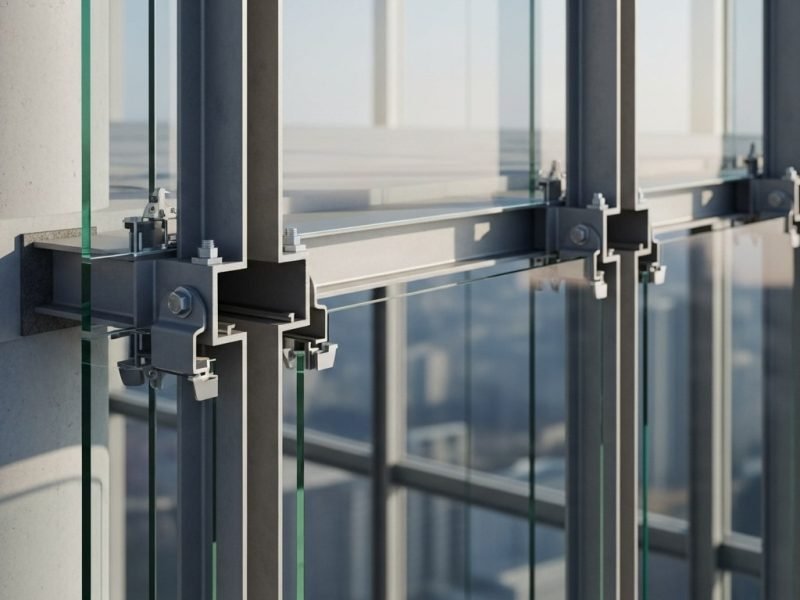
Curtain wall systems are widely use in modern architecture for their aesthetic appeal and functional performance. An important aspect of this system is the vertical space support, better known as the vertical keel. The support usually carries square steel or steel linings embedded inside it to increase strength and stability. This structural safety can then be utilized or recommended in building projects that may be integrated with designs of Casement Window, Commercial Window, or large Sliding Window facades in curtain wall designs.
Why is Steel Added to Curtain Wall Vertical Supports?
Improved Wind Resistance
Heavy wind pressure must be withstood by the curtain wall supports encompassing high-rise buildings and coastal areas with strong winds or typhoons when a steel core is added to the structure. It would exhibit far greater bending and shear resistance while not permitting deformation or breakage. This particular method of reinforcement becomes especially important with a Commercial Window installation that usually exhibits large glass surfaces to direct wind loading.
Enhanced Structural Rigidity
Nearly three times as stiff as most aluminum alloys, it doesn’t flop under load and keeps the panels flat if used in vertical supports. This is particularly important where Casement Window systems or Sliding Window systems are use. Those systems must have minimal deviation for accurate sealing and smooth operation.
Support for Large-Span Designs
Pure aluminum is generally insufficient for the internal structural rigors needsas in wide-span curtain walls. Reinforcing with steel provides extra strength necessary to cope with large glass panels typical for Sun Room projects featuring extensive glazing.
Seismic Performance
It is ductile enough to absorb seismic forces better than aluminum, providing for less brittle failures. This is especially important for tall buildings that contain Swing doors and sliding doors within the curtain wall system.
Stronger Connection Nodes
Where vertical support meets the structure of a building, there should be very good durability. Steel held together via bolt and weld affixes long-term stability and safety.
Cost-Effective Solution
Combining steel cores with aluminum, other than enlarging aluminum profiles, increases both strength and economy with reduced material costs and contemporary appearance.
Common Implementation Methods
- Steel-core aluminum vertical supports: Square steel or I-beams embedded into aluminum profiles with bolts or durable adhesives.
- Steel-aluminum composite columns: Favorable to applications in projects such as super high-rise, carrying heavy loads.
- Localized reinforcement: Steel localized reinforcement was added in the areas that are considered to incur high load stresses, such as the corner and cantilever reinforcement points.
These methods find widespread applications in projects with Sliding Window walls or sunrooms that extend outwards.
Important Precautions in Steel Reinforcement
- Corrosion protection: Galvanization or painting of iron metal before coupling with aluminum to avoid corrosion.
- Thermal bridge: For thermal loss reduction, the thermal insulation strip or gasket should be installed at this point.
- Accurate calculations: Structural design shall be in accordance with the JGJ 102 Glass Curtain Wall Engineering Technical Specifications and other engineering codes.
Step-by-Step Process of Reinforcement
- Design Stage: Load analysis, material selection (Q235/Q355 steel), and composite design for steel-aluminum coordination.
- Node Design: Methods of linking, measures for corrosion protection, and insulation material selection.
- Drawing Development: Detailed drawings on placing and assembling steel.
- Manufacturing: Steel cuts, treatment by galvanizing, aluminum cutting, and an insulating layer for heat.
- Assembly: Placement of steel into aluminum profiles through bolts or adhesives and joint sealing.
- Installation: Positioning, welding/bolting to the main structure, and leveling supports.
- Final Inspection: Checking strength, corrosion resistance, airtightness, and watertightness.
Advantages of Steel Reinforcement in Curtain Walls
- Higher wind and seismic resistance.
- Higher lifetimes of curtain wall systems.
- Compatibility with large glass spans.
- Higher energy efficiency with proper insulation.
- More cost-effective than pure steel structures.
Disadvantages to Consider
- Increased weight compared to pure aluminum supports.
- Requires additional anti-corrosion treatment.
- More complex design and construction process.
- Potential thermal bridging without proper insulation.
Conclusion
The use of square steel in curtain wall vertical supports is a proven strategy for ensuring strength, safety, and long-term durability. It is especially beneficial in modern architectural designs that integrate Casement Windows, Commercial Windows, Sliding Windows, Swing Door, Sliding Door, and Sun Room systems. By combining aluminum and steel, builders achieve a balance of strength, energy efficiency, and visual appeal.
For architects and engineers, the decision to reinforce with steel is not just about structural safety but also about delivering sustainable, cost-effective, and aesthetically pleasing building solutions.